Support for the Adoption of Solutions
This type of support aims to support repositories in adopting solutions that will improve their trustworthiness. This mix of financial support and expert guidance will introduce best practices, tools, services, and other solutions and show how repositories can get to work to implement these for their own organisation. The solutions that will be offered will be curated to match with community needs, such as those indicated in the landscape survey. We will also align with ongoing developments in the landscape and other projects and initiatives to establish useful bidirectional feedback loops that help both repositories advance and developers improve their work.
For each solution that is selected to be offered, a clear description of the support will be provided, including a description of the expertise that will be shared (and by whom), the work that is expected to be done by participants, any expected skills or knowledge participants should already have, and the final results that repositories will gain from their participation. For further information about logistics and the application process, please carefully consult the Frequently Asked Questions. For more information about our provisions for inclusivity, please visit the dedicated webpage.
For any remaining questions, or suggestions for solutions to include in our open calls, please contact us at training-fidelis@postit.csc.fi
Open calls for the Support for the Adoption of Solutions
| Pilot round (2025 - closed) |
| The pilot support offers included : Enhancing Repository Transparency and Trustworthiness with TTRAM (Support 1), Core TrustSeal Support : Explorer Track & Pathfinder Track (Support 2), Develop your own FAIR EVA plugin (Support 3) |
| Open Call #1 (2026) |
| The first Open Call for the Support for the Adoption of Solutions was launched on 30 April 2026 and will remain open until 30 June 2026. All information about the available support offers can be explored at the Support for the Adoption of Solutions dedicated page. |
| Open Call #2 (2027) |
| The second Open Call for the Support for the Adoption of Solutions will launch in March 2027. All information about the available support offers will be displayed here. |
Mentoring and peer-to-peer support programme
FIDELIS will provide access to a pool of FIDELIS and external mentors on specific topics, aiming to build capacity and to lay the foundation of the peer-to-peer support ethos that the FIDELIS network will thrive on.
A strong repository community that shares knowledge is a core element of the FIDELIS Network. Through our co-developed support programmes, FIDELIS will facilitate mentoring and peer-to- peer knowledge exchange to support skills development and to foster collaborative approaches to tackling common challenges. Financial support will be provided to external mentors to enable them to co-design and participate in one of the defined support programmes. We will have two open calls for mentors to apply to join our mentoring and peer-to-peer support programmes over the life of the project. Topics for the support programmes align with one or more elements of the Transparent Trustworthy Repository Attributes Matrix (TTRAM).
The five topic areas being offered for the first open call which launches on 27 February 2026 are:
Trustworthiness is a continuous journey, and all Trustworthy Digital Repositories and those aspiring to become one encounter many similar challenges and experiences. National and international connections can be useful for peer exchange and to build required or desired policies, standards, and guidance together. This programme aims to provide support for knowledge exchange and welcomes mentors with experiences in a wide range of self-assessments and certification for trustworthiness. This may include:
- Experience in applying for - or renewing - formal certified status (e.g. CoreTrustSeal, Nestor seal, ISO 16363);
- Experience in self-assessing repository practices;
- Experiences with national infrastructures and collaboration initiatives;
- Experiences with developing national policies and/or shared standards;
- Experience in making information about the repository governance, policies, sustainability and/or workflows transparent
- Experience in aligning repository functions with guiding principles such as FAIR, CARE, and TRUST.
Please note that the list of examples above is not exhaustive and we welcome additional suggestions from applicants on experiences that might be shared. The support programme will be created to provide insights and advice for peers looking to start or advance their own certification process, or to continuously improve their trustworthiness and transparency independently from such schemes. This support programme topic relates to TTRAM Activity/Function 14 Policy & Standards.
The FIDELIS mentors you will be working with: Data Archiving and Networked Services (DANS) [lead], GESIS - Leibniz Institute for the Social Sciences, Gdańsk University of Technology, French Ministry of Higher Education and Research, Recherche Data Gouv
Trustworthy Digital Repositories play a critical role in providing long-term access to data that are findable, accessible, interoperable and reusable (FAIR). Repositories often have a wide range of policies and procedural documents in place which govern what deposits will be accepted and from whom; which format(s) will be accepted; the level of curation that deposited items will receive; and how long deposited items will be retained. Increasingly, there is an emphasis on making much of this information transparent to improve trustworthiness. This programme aims to provide support for knowledge exchange about formal and informal approaches that are being defined or undertaken within repositories to define and implement policies and to make this work more transparent. We welcome applications representing a broad range of experiences under this theme. This may include:
- Experience in developing repository policies
- Experience in implementing repository policies
- Engaging with relevant stakeholders on policy development and implementation
- Assessing resources required to implement and/or monitor policies
- Harmonisation of policies across repositories and/or other stakeholders
- Making policies and procedural information more transparent
- Aligning with policies of other stakeholders (e.g., funding bodies; disciplines, RPOs)
Please note that the list of examples above is not exhaustive and we welcome additional suggestions from applicants on experiences that might be shared.
This support programme topic relates to TTRAM Activity/Function 14 Policy & Standards.
The FIDELIS mentors you will be working with: Digital Curation Centre (DCC) [lead], GESIS - Leibniz Institute for the Social Sciences, Swiss Bioinformatics Institute (SIB)
Repository services and functionality should reflect the needs of the communities they serve. Engagement with end users helps to ensure that the repository is fit for purpose but can also lead to better co-curation of content during the earlier stages in the research lifecycle and increased use of deposited content. This programme will provide support for knowledge exchange on approaches to fostering engagement between repositories and their users. We welcome applications representing a broad range of experiences under this theme. This may include:
- Experience in gathering user requirements
- Experience in supporting creation and improvement of metadata and other documentation
- Highlighting the benefits of using (curated) repositories
- Promoting the repositories to different stakeholders
- Evaluating ways and formats of communication including language use
- Relationship building with depositors
- Developing community engagement plans
Please note that the list of examples above is not exhaustive and we welcome additional suggestions from applicants on experiences that might be shared.
This support programme topic relates to TTRAM Activity/Function : External Engagement
The FIDELIS mentors you will be working with: The Arctic University of Norway (UiT) [lead], University of Belgrade , Digital Curation Centre (DCC)
All actions that lead to trustworthiness require good foundation stones - namely, the technical infrastructures on which repositories rely. Both at hardware and software levels, building/maintaining a qualitative infrastructure and actively working on enabling proper data curation are key to many higher level activities. This support programme welcomes mentors with experiences in building, maintaining and improving high quality technical infrastructures for digital repositories, that enable and facilitate data curation. This may include:
- Provision of hardware, software and IT services, including experience with service management methodologies
- Experience in providing resilient infrastructures with appropriate mechanisms (failover, loadbalancing, backup processes, etc.)
- Experience with assessing and/or advancing the levels of curation and preservation offered by the repository
- Experience with ensuring digital objects meet a defined level of quality and standards compliance before they are made available for reuse
- Experience with providing discovery systems and making metadata available for harvesting
- Experience in providing secure access to sensitive data
- Experience with setting up workflows and approaches to meet defined criteria for access and reuse and potentially to enable preservation, including any curation steps like conversions to file formats and any additions to metadata.
- Monitoring the user community technical needs
- Experience with creating Technical Infrastructure Statement, Technical Infrastructure Plan, and/or IT Service Management methodologies
Please note that the list of examples above is not exhaustive and we welcome additional suggestions from applicants on experiences that might be shared.
This support programme topic relates to TTRAM Activity/Functions 28 Storage & Integrity; 29 Technical Infrastructure; and 30 Security.
The FIDELIS mentors you will be working with: French Ministry of Higher Education and Research, Recherche Data Gouv [lead], Gdańsk University of Technology, Swiss Institute of Bioinformatics, University of Belgrade
Running a trustworthy and transparent repository service requires the availability of skilled staff and the effective management of human resources to fulfil the repository’s current mission and to realise future aspirations. This programme aims to provide support for knowledge exchange about formal or informal approaches that can be undertaken within repositories to build capacity among staff and to make capacity building activities more visible and reusable. We welcome applications representing a broad range of experiences under this theme. This may include:
- Mapping staff competency against repository functions
- Identifying knowledge and skills gaps
- Defining skills development plans and learning paths for staff
- Improving pedagogic capabilities amongst educators and trainers
- Making educational resources more reusable and transparent
- Facilitating peer-to-peer knowledge exchange activities
- Securing external skills to fill gaps
- Resourcing professional development for staff
- Provide support for career progression
Please note that the list of examples above is not exhaustive and we welcome additional suggestions from applicants on experiences that might be shared.
This support programme topic relates to TTRAM Activity/Function 17: People & Expertise.
The FIDELIS mentors you will be working with: Swiss Institute of Bioinformatics, Digital Curation Centre (DCC), Gdańsk University of Technology, Data Archiving and Networked Services (DANS)
What are we looking for in mentors?
You do not need to be an ‘expert’ to take part as a mentor for a given support programme topic. You just need to have some relevant experience to share.
We want to provide a broad range of experiences and perspectives for each support programme which may include implementing a particular technical tool or approach; supporting and/or engaging repository users; serving a particular domain or user community; policy development and implementation; longer-term sustainability; developing and/or adhering with standards. Please note that this list is not exhaustive and we welcome you to suggest other aspects of experience that you could offer. The experience you share does not always need to be positive. We welcome applications from those with experiences that didn’t quite go to plan as well as those with success stories. Both are equally valuable!
Up to five successful applicants to the open call for mentors will work with FIDELIS mentors to co-design a short programme for the specific support programme. Together, you will determine the number and timing of the virtual meetings and/or workshops that will facilitate knowledge exchange. Please note that the mentoring or peer-to-peer support programme must be provided virtually. FIDELIS will provide the technical infrastructure to enable this.
Below is the overview of the expected contributions from successful applicants.
How to become a mentee in the support programmes?
What are we looking for in mentors?
You do not need to be an ‘expert’ to take part as a mentor for a given support programme topic. You just need to have some relevant experience to share.
We want to provide a broad range of experiences and perspectives for each support programme which may include implementing a particular technical tool or approach; supporting and/or engaging repository users; serving a particular domain or user community; policy development and implementation; longer-term sustainability; developing and/or adhering with standards. Please note that this list is not exhaustive and we welcome you to suggest other aspects of experience that you could offer. The experience you share does not always need to be positive. We welcome applications from those with experiences that didn’t quite go to plan as well as those with success stories. Both are equally valuable!
Up to five successful applicants to the open call for mentors will work with FIDELIS mentors to co-design a short programme for the specific support programme. Together, you will determine the number and timing of the virtual meetings and/or workshops that will facilitate knowledge exchange. Please note that the mentoring or peer-to-peer support programme must be provided virtually. FIDELIS will provide the technical infrastructure to enable this.
Below is the overview of the expected contributions from successful applicants.
Interested in receiving any of the offered support programmes? Fill out the form below!
Fill out the mentee support form
| Training for the mentors on the approach to be taken and expected outcomes | 0.5 days |
| (May 2026) Thematic leads and mentors work to develop the mentoring support programme based on the experience that is represented across the FIDELIS team and mentors. Aspects to be co-defined include the number of sessions, how many mentees they can accept; if observers can be accepted, length of sessions, communications between sessions, any homework, feedback from mentees to demonstrate knowledge exchange. | 2.0 days |
| (June-September 2026) Preparing for and delivering the mentoring and peer to peer support programme. The exact number of sessions and timing will be defined by the pool of mentors for each support programme. | 4.0 days |
| (October 2026) Preparing for and taking part in a FIDELIS Mentor peer exchange session (for mentors to share their experiences on participation). | 1.5 day |
| Drafting of a co-authored FAIR Implementation Story to share the key lessons learned. This will take place during October. | 2.0 days |
| Option to contribute to an open webinar to promote the implementation story and to share the findings more widely. | |
| Total time commitment for mentors between May-December 2026 | 10 days |
Implementation Stories
All support activities derived from our open calls will conclude with the collaborative writing of an Implementation Story. One Implementation Story is written for each support offer by the FIDELIS support team and the participants, describing the main challenges encountered as well as lessons learned and provides key messages and advice to peers looking to improve their skills on the same topic, now or in the future. Implementation Stories were initially created by the FAIRsFAIR project, and later successfully continued by the FAIR-IMPACT project, to facilitate wider sharing of knowledge and practical experience between peers.
Explore the recently published implementation stories :
General FAQs
FIDELIS will run four open calls for training and support activities
2 for the Support for the Adoption of Solutions
2 for the Peer-to-peer mentoring programme
All calls will be open for a period of two months. This results in the following timelines for when each open call will be available for applications:
First open call for Peer-to-peer Mentoring programme: February-April 2026
First open call for Support for the Adoption of Solutions: April-June 2026
Second open call for Peer-to-peer Mentoring programme: January-March 2027
Second open call for Support for the Adoption of Solutions: March-May 2027
Delivery of the training and support can start from one month after the closing of the call, but this may vary across calls and support offers. Dates of delivery are clearly indicated on the information pages around any active open call.
Open calls will be available for two types of training and support:
2 open calls for Support for the Adoption of Solutions
2 open calls for Peer-to-peer mentoring
For more information about these different types of training, as well as the open training activities, see the FIDELIS training and support area.
We welcome applications from individuals or small teams from public and private organisations in the repository landscape. The training and support primarily targets repositories, but if a support offer is also open to other service providers this will be explicitly mentioned in the support offer description.
Please note that individuals and teams from organisations that are part of the FIDELIS consortium are not eligible to receive financial support. However, they are welcome to apply to participate as observers in the support for the adoption of solutions and as unpaid mentors in the peer to peer support programme if this role is indicated as available. Before submitting an application, please consult the list of FIDELIS partners.
Please note that applications from countries outside of Horizon Europe or the Associated Countries are not eligible to receive financial support. However, they are welcome to apply to participate as observers in the support for the adoption of solutions and as unpaid mentors in the peer to peer support programme if this role is indicated as available.
The amount of financial support that is included in a support offer will be explicitly mentioned in the support offer description. This amount will reflect the estimated time investment of participation in the support offer.
Financial support for the Adoption of Solutions will never exceed 10.000 Euros. Financial support for the mentoring will never exceed 5.000 Euros. All grants will be received after satisfactory completion of participation in the support offer, which is determined by contribution to the Implementation Story.
Every organisation that applies for the open calls can receive up to maximally 20.000 Euros of financial support from FIDELIS in total.
Financial support to third parties (grantees) raises the following contractual obligations:
Prevention of Conflict of interest;
Confidentiality and security;
Ethics and values;
Visibility;
Information, and;
Record-keeping.
Under FIDELIS’s obligations to its funder, concerned with checks, reviews, audits and investigations, certain bodies (i.e., the European Anti-Fraud Office (OLAF), the European Public Prosecutor’s Office (EPPO), and the European Court of Auditors (ECA)) can also exercise their rights towards the recipients of funding from FIDELIS.
The above are in line with the European Commission’s rules for providing support to third parties. Full information on all of the above will be contained in the contracts issued to successful applicants.
Yes - you are very welcome to apply to participate as an observer in the support for the adoption of solutions and/or as an unpaid mentor in the peer to peer support programme if the role is indicated as available. Please be sure to make this clear in your application.
To apply to any support offer in any of the open calls, an application form must be filled in and submitted during the period in which the call is open. Accessing and submitting the application form will be done through the TRUST Grants platform. To access this platform, you need to create an account for the EDEN-FIDELIS website first. After logging in on the website, you will then be able to access the open calls dashboard. You can save a draft of your application and return to it at a later date if necessary.
Your application will be evaluated by three separate evaluators, each with no conflict of interest, according to a structured rubric. The evaluations indicate whether your application fits with the support that will be offered and whether you satisfy the expectations set out in the call description. We aim to ensure a good representation of different viewpoints so we will aim to ensure a good balance from different geographic areas, different repository types and levels of maturity, and different disciplines.
These evaluations will not be shared. Successful applicants will be published on the website after the conclusion of the evaluations.
Each support offer details the maximum number of participants supported in their description.
If you have registered for one or more support offers but would like to retract this registration, please contact: training-fidelis@postit.csc.fi
Please do reach out to retract if you are unable to participate after all, as this will allow other repositories to participate in the support offer instead.
An Implementation Story is a public document that describes the experiences, challenges and lessons learned during the training and support. All participants to the support offers will contribute to the production of an implementation story. The main purpose is to provide others with useful information, tips, and advice to improve their trustworthy attributes.
Templates will be provided to ensure consistency in the presentation of the stories. One Implementation Story will be created for each support offer, with all participants included as co-authors. These will be made available via the FIDELIS website and Zenodo community.
Implementation Stories were originally developed as part of the FAIRsFAIR project. They illustrate good practices in research communities and organisations to support the implementation of the FAIR principles. Links to the FAIRsFAIR Implementation Stories can be found on the FAIRsFAIR website. This practice continued in the FAIR-IMPACT project, where FAIR Implementation Stories were created by training participants and are publicly available.
No, becoming a member of the FIDELIS Network follows its own process. Find out more information on how to become a Network member here.
No, it is not mandatory to participate in training to become a FIDELIS Network member. Find out more information on how to become a Network member here.
Yes, FIDELIS Network members are very welcome to apply to our open calls. Please do consider if you adhere to the other eligibility criteria (see “Who can apply to the open calls?”) before submitting your application.
The Training and Support offered in the FIDELIS project have to adhere to the rules governing open calls for cascading grants. Therefore, we do not prioritise applications from FIDELIS Network members over other applications with higher evaluations. FIDELIS Network members will have closer contact with the FIDELIS Training and Support team to ask any questions or share suggestions to help shape the programme into the future.
Yes, you are able to submit applications to multiple open calls. However there is a maximum to the financial support you are able to receive of 15.000 Euros. Should you surpass this limit, you may still participate without receiving financial support, if this role is available for the open call.
Absolutely! We aim to provide the training and support that is most desired by the community and therefore appreciate hearing any suggestions from the community on topics or solutions that we could develop training or support on. Please include information on relevant resource links as well as existing experts that may collaborate on the training in your suggestion. Note that we cannot guarantee each suggestion will be executed, taking into account our training strategy, timeline, and resources.
If you have a suggestion to share, please contact us at: training-fidelis@postit.csc.fi
Support for the Adoption of Solutions FAQs
This form of support offered by the FIDELIS project aims to support repositories in adopting solutions that will improve their trustworthiness. This mix of financial support and expert guidance will introduce best practices, tools, services, and other solutions and show how repositories can get to work to implement these for their own organisation.Across the two open calls, FIDELIS will allocate a total of 500,000 euros in cascading grants to support repositories in adopting and implementing these solutions.
Applications are submitted via the open calls grants platform.
As part of your application you will be asked to provide:
- Whether you are applying as a participant or an observer
- Your name, contact details and organisational affiliation. Where the application is being made on behalf of a group, a nominated lead participant will need to provide these details;
- The country you are based in;
- The discipline(s) you work in;
- Confirmation of participation in all virtual workshops and/or other meetings detailed in the support offer description (by at least one member of the participating team);
- Confirmation that the funds can only be claimed upon successful completion of the support offer;
- Confirmation of contribution to the co-authored Implementation Story.
In addition to this information, you will be asked to clearly demonstrate the following:
- Your possession of the expected expertise, knowledge, skills, and resources as described in the support offer description;
- How your participation in the given support offer will benefit your organisation and how you plan to build on the outcomes;
The application form for each support offer will be slightly unique as it may include additional elements and/or questions to better select the most suitable participants.
Each support offer will have its own design based on the topic and intended outcomes. A specific description of the support provided for each support offer will be presented on the page describing each open call.
In general, the Support for the Adoption of Solutions will include:
- Several virtual workshops (introductory webinars and hands-on sessions);
- Advice and support from associated FIDELIS members;
- Expert guidance - generic as well as tailored to your questions;
- Opportunities for peer engagement with the other participants;
- A grant of financial support depending on the amount of effort required by the specific support offer (ranging from 5.000 to 10.000 Euros).
This form of support is intended to help repositories strengthen their trustworthiness. Applications should therefore be submitted by a representative of the organisation. You may apply as a single participant or on behalf of a group within your organisation. When applying on behalf of a group, one participant must be nominated as the lead applicant to complete and submit the application.
Each support offer will have its own design based on the topic and intended outcomes. The specific requirements and expectations for each support offer will be detailed on the page describing the open call.
In general, for the Support for the Adoption of Solutions, you will be expected to:
- Attend all virtual workshops (at least one person should attend if you work in a team);
- Execute independent work in between the workshops (e.g. implementing the solution in your organisation, testing a pilot-solution, providing feedback and input, etc.);
- Contribute to the collective Implementation Story, where experiences and lessons learned about the solution will be publicly shared
Applicants are notified after the evaluation process has concluded in July 2026.
Each support offer details the maximum number of participants supported in their description.
The funds are to be used solely for supporting staff time to carry out the support offer activities and not to be used to support travel, catering or purchasing of equipment.
Reporting is completed by contributing to an Implementation Story. Payment is made after the successful completion of the support activities and is expected to take place in December 2026.
Peer-to-peer and mentoring support programme FAQs
FIDELIS will offer at least four thematic support programmes that mentors can apply to participate in for each open call. Each thematic area will be broad enough to allow for a range of different kinds of knowledge and practical experiences to be proposed by potential mentors through the short application form.
Mentors are those who have some knowledge and/or practical experiences to share in relation to the selected theme. Successful applicants to the open call for mentors will work with a minimum of two members of the FIDELIS team and up to four other mentors to co-design and deliver the support programme to foster practical skills acquisition or knowledge exchange in the particular thematic area.
No! We want to have a broad range of experience represented in the mentors. You just need to have something useful to contribute to the topic.
You should apply in a personal capacity as it is your experience that we will be leveraging.
Mentees are those who will benefit from knowledge exchange by participating in the support programme.Please note that we believe all participants will have valuable views to share and there is an expectation that mentees participate actively so that knowledge exchange is bi-directional.
No. Mentees will not receive any financial support for their participation. However, participation in the support programme will be free for mentees.
You can use this webform to express interest in joining one or more support programmes as a mentee.
Once the mentors have been selected, the support programme sessions will be co-developed with FIDELIS mentors. The programme details will be shared with these with those expressing interest so they can then decide if they wish to register to join. Participation in the programme for mentees is free.
As part of your application you will be asked to provide:
- Your name, contact details and organisational affiliation.
- The country you are based in;
- To confirm which Support Programme you are applying to participate in;
- Confirmation of commitment to the planned 10 day activities and confirmation of contribution to the co-authored Implementation Story.
In addition to this information, you will be asked to clearly demonstrate the following:
- A brief summary of the relevant knowledge and/or practical experience that you can share in relation to the thematic area you are applying to participate in.
- Provide a short summary of any policies, publications, tools, services, guidance and/or training that you have been involved in developing that may be relevant for this thematic area.
- How you will share and disseminate the experiences and lessons learned in your wider community.
Each support programme will have its own design based on the topic and intended outcomes.
All Peer-to-peer mentoring programmes will include:
- Financial support for successful applicants to co-design and deliver the support programme with FIDELIS mentors. A maximum of 5,000 euros will be paid to successful applicants upon successful completion of the support programme.
- Technical infrastructure and administrative support to schedule and deliver the virtual meetings and/or workshops.
- Pedagogical support for the mentors to guide the co-development of the support programme.
- A template to support co-authoring of the Implementation Story and peer review of the story.
- Coordination of the open webinar to share the outcomes of the support programme.
Each support programme will have its own design based on the topic and intended outcomes.
In general, for the Peer-to-peer mentoring, you will be expected to:
- Attend the contact points, workshops, and peer exchange agreed on;
- Contribute to the creation of the support programme;
- Contribute to the delivery of the support programme;
- Contribute to the collective Implementation Story, where experiences and lessons learned about the solution will be publicly shared.
Provisions for Inclusivity
FIDELIS is committed to provide training and support for the entire European repository landscape, allowing all to improve their relevant skills and potentially onboard onto the FIDELIS Network. In these efforts, we recognise there are parts of the community where underrepresentation in previous training and support activities, lower certification rates, and limited access to resources and development can be observed. Taking into account these factors, the FIDELIS training and support strategy includes specific attention to balanced representation and describes specific actions we will take to ensure this.
To facilitate increased inclusivity, FIDELIS aims to:
- actively facilitate increased representation in our training and support programmes of countries that have previously been less well represented, so their repositories can be strengthened and improve important skills
- actively facilitate repository networking throughout Europe and allow onboarding onto the FIDELIS Network by all countries.
- improve understanding of the unique challenges, needs, and questions that are prevalent in these areas and may be different from previously identified topics in the repository landscape.
Bulgaria
Croatia
Cyprus
Czechia
Estonia
Greece
Hungary
Latvia
Lithuania
Malta
Poland
Romania
Slovakia
Slovenia
Albania
Armenia
Bosnia and Herzegovina
Georgia
Kosovo
Moldova
Montenegro
North Macedonia
Serbia
Türkiye
Tunisia
Ukraine
What does the targeted focus entail?
We will work to develop contact points with representatives in each country, reaching out to them to inform them of relevant information, events, outcomes, and training and support opportunities in the project. This personal contact will allow you to ask any questions you may have about participation or content directly to the team, to lower the barrier to connect with the project. If you would like to be included in our direct contact list as a representative of a specific targeted country, please reach out to us at: training-fidelis@postit.csc.fi
We will also organise events to identify the most relevant topics, formats, and characteristics of our training and support for the specifically targeted countries. If these are unique to only a small portion of the landscape, we may organise dedicated events in the national context to address them, in collaboration with our contact person(s).
Our open calls will also include strands designed to address topics and challenges of relevance to the target group, and will take specific care to include applications from targeted countries when other eligibility criteria are also satisfied. The built-in focus on peer exchange in the support offers will facilitate participants to expand their network and establish meaningful connections with other knowledgeable peers and experts in the field.
First Open Call for Mentors and Peer-to-Peer Learning
During the review and selection process, attention was given to a balanced selection of gender (50% male, 50% female) and country (17 countries represented by awarded applicants). AProgrammes #1 and #5 were specifically designed based on community feedback for less advanced repositories, and we used additional communication strategies to attract a wide range of countries to the open call. This resulted in 31% of total applications and 40% of all funded applications coming from the selected countries. Below you will find the list of countries that will be represented in the support programmes for 2026:
- Bosnia and Herzegovina
- Denmark
- The United Kingdom
- Spain
- Latvia
- Germany
- France
- Serbia
- Greece
- Poland
- The Netherlands
- Lithuania
- Romania
- Belgium
- Tunisia
- Austria
- Portugal
To connect to the FIDELIS team in representation of your country, you can reach out to: training-fidelis@postit.csc.fi
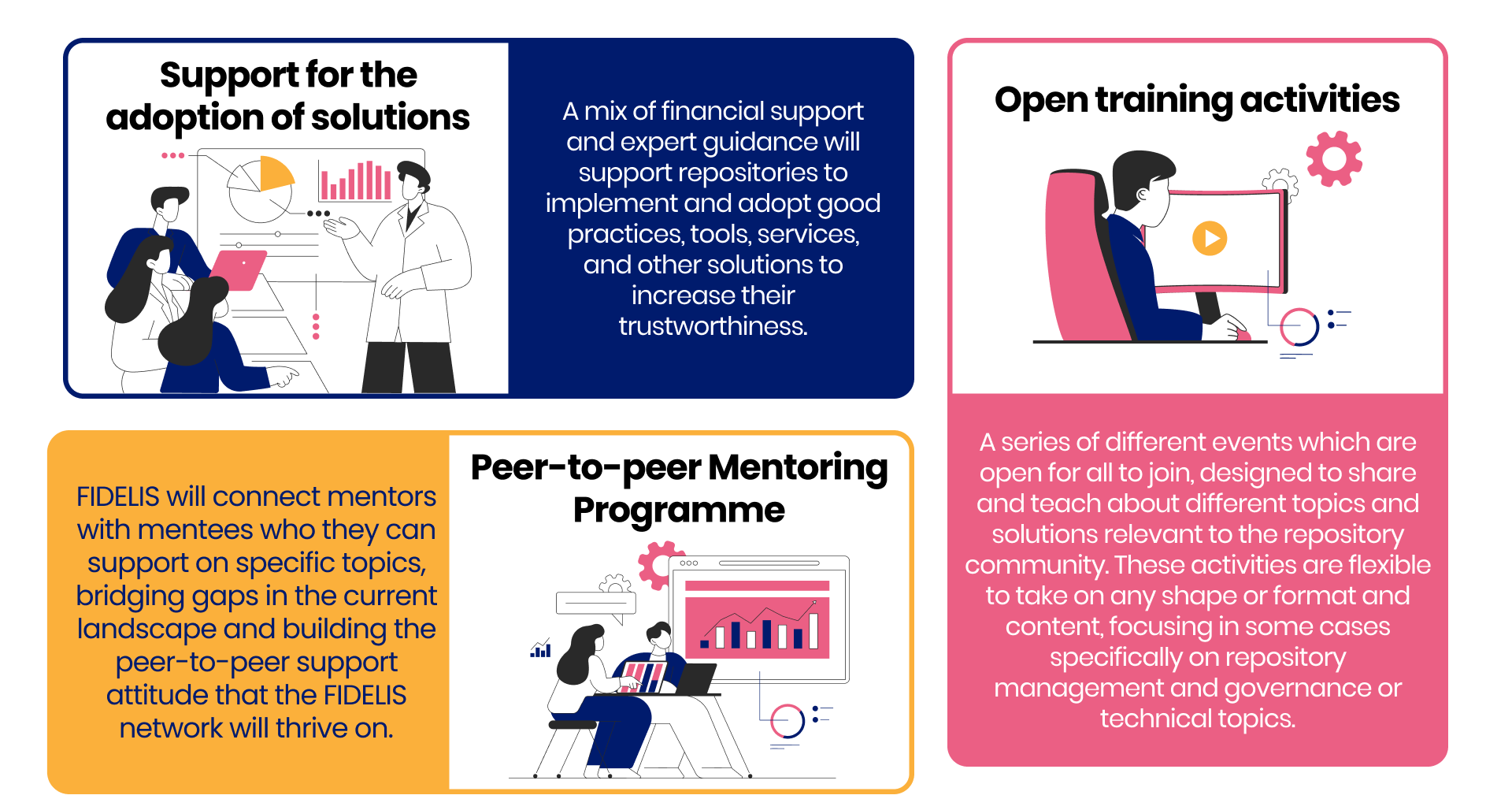 FIDELIS will offer three different types of support and training: